Your cart is currently empty!
You may check out all the available trips and book one that suits you.
Continue Browsing Trips
You may check out all the available trips and book one that suits you.
Continue Browsing TripsThe Ateshgah Fire Temple is one of Azerbaijan’s most fascinating historical and religious landmarks. Located in Surakhani, approximately 30 kilometers from central Baku, this remarkable temple complex reflects the country’s ancient connection with fire and its role as a meeting point of different cultures and religious traditions.
The name Ateshgah comes from Persian and means “House of Fire” or “Place of Fire.” For centuries, natural flames emerging from the ground attracted travelers, pilgrims, and worshippers who considered fire a sacred element.
Today, Ateshgah is one of the most popular attractions on the Absheron Peninsula, offering visitors a unique glimpse into Azerbaijan’s religious and cultural history.
The Sacred Fires of Absheron
Azerbaijan has long been associated with natural flames, earning its reputation as the Land of Fire.
The Absheron Peninsula is rich in underground oil and natural gas deposits. In certain locations, gas escaping through cracks in the earth once ignited naturally, creating flames that could burn continuously.
These extraordinary natural phenomena attracted the attention of ancient communities and contributed to the development of religious traditions associated with fire.
The Surakhani area is traditionally linked to ancient Zoroastrian fire worship, although the exact history and location of any earlier sanctuary remain uncertain.
History of the Ateshgah Fire Temple
The present-day Ateshgah complex was constructed mainly during the 17th and 18th centuries by Indian merchants and pilgrims who traveled to Baku along historic trade routes.
Many of these visitors came from northern India and belonged to Hindu and Sikh religious communities.
As commercial connections between Azerbaijan and India developed, Surakhani became an important destination for pilgrims attracted by the natural flames.
Wealthy Indian merchants helped finance the construction of prayer rooms, residential cells, and other buildings surrounding the sacred fire.
Some of the earliest surviving structures date to the early 18th century, while the central fire altar was built in its present form in the early 19th century.
Stone inscriptions written in Devanagari and Gurmukhi scripts can still be seen on the walls of the complex, providing valuable evidence of its historical connections with India.
Architecture of Ateshgah
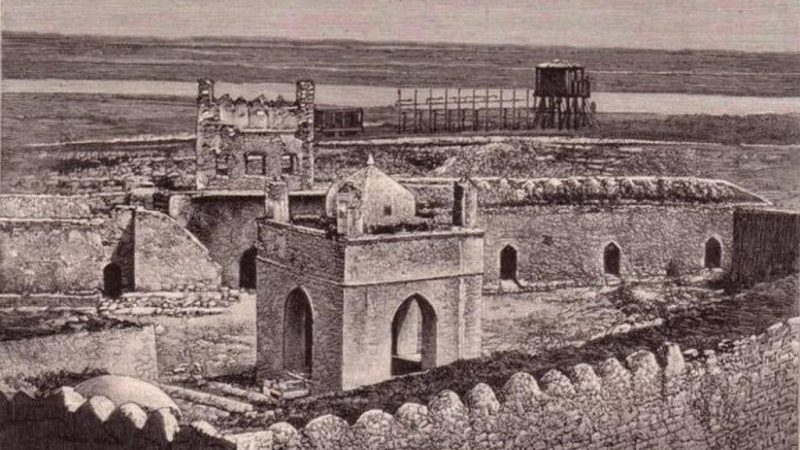
Ateshgah is a distinctive pentagonal complex surrounded by high stone walls.
Its architecture combines local Absheron building traditions with elements associated with religious fire sanctuaries.
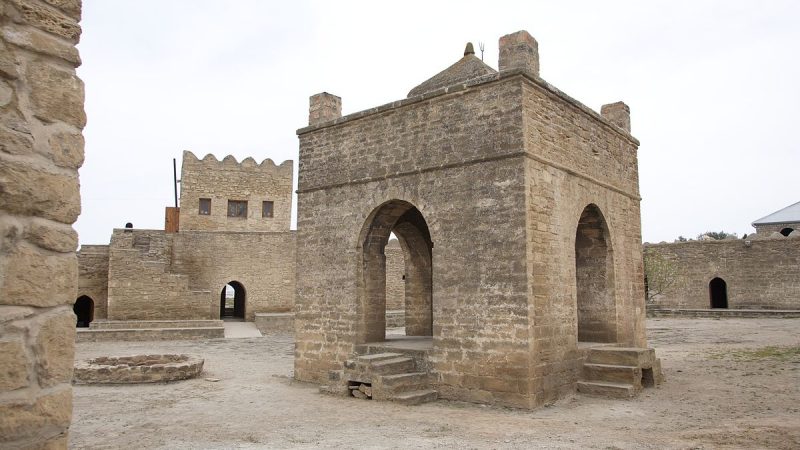
The main entrance leads into an open courtyard surrounded by small rooms that once served as prayer chambers, living quarters, and accommodation for pilgrims.
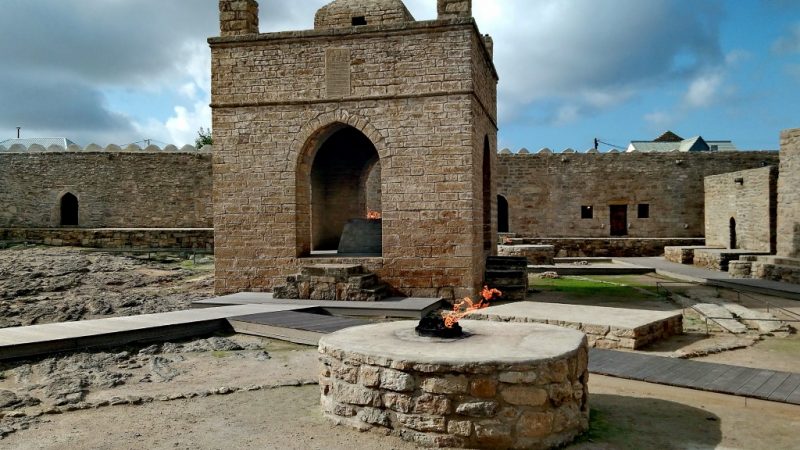
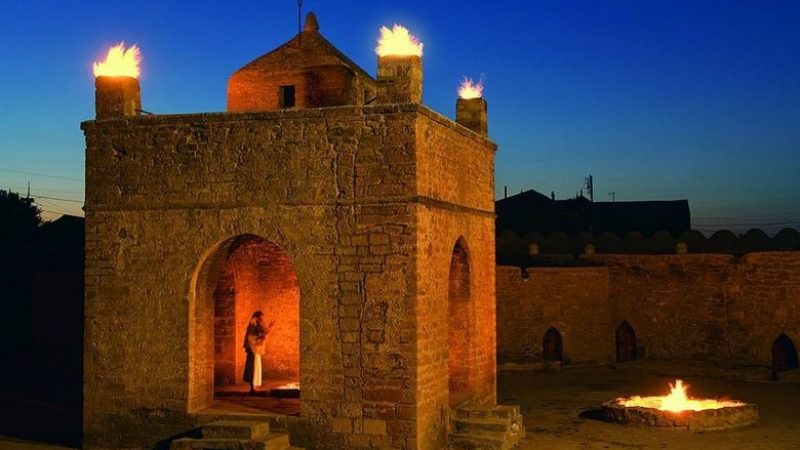
At the center of the courtyard stands the temple’s most recognizable feature: a four-sided stone altar topped with a traditional domed structure.
Flames burn at the altar, recalling the natural fires that originally made this location sacred.
The surrounding chambers now contain museum exhibits illustrating the history of the temple and the daily lives of its former inhabitants.
Life of the Pilgrims
During the 18th and 19th centuries, Ateshgah was home to a small community of religious pilgrims and ascetics.
Many followed strict spiritual practices involving meditation, prayer, fasting, and self-discipline.
Some ascetics practiced extreme forms of physical hardship as part of their religious devotion.
The community was supported largely by donations from visiting merchants and pilgrims, particularly those traveling from India.
The temple served not only as a place of worship but also as a center of spiritual life and cultural exchange between different communities.
The Disappearance of the Natural Flames
During the 19th century, the natural gas supply feeding the sacred flames gradually declined.
The development of oil and gas extraction in the surrounding region contributed to changes in underground gas pressure, eventually causing the natural flames to disappear.
As the flames faded, the temple gradually lost its importance as an active place of worship.
By the late 19th century, the remaining religious community had largely departed, and Ateshgah ceased functioning as a traditional pilgrimage center.
Today, the flames visible at the temple are maintained using a supplied gas source rather than the original natural gas emissions.
Ateshgah as a Museum
Following restoration work, the Ateshgah Fire Temple opened to visitors as a museum in 1975.
Today, the complex preserves the architectural features of the historic sanctuary while introducing visitors to its religious and cultural heritage.
Museum displays include historical inscriptions, reconstructed scenes of pilgrims’ daily lives, and information about the temple’s connections with India and the ancient fire traditions of Azerbaijan.
Visitors can explore the courtyard, examine the prayer chambers, and admire the central fire altar.
Visiting Ateshgah Fire Temple
Ateshgah is one of the most interesting historical attractions near Baku and an essential destination for visitors exploring the Absheron Peninsula.
The temple offers a fascinating combination of architecture, history, religion, and natural phenomena.
A visit to Ateshgah is often combined with Yanardag (Burning Mountain), another famous attraction where natural gas flames emerge directly from the hillside.
Together, these two landmarks provide an unforgettable introduction to Azerbaijan’s identity as the Land of Fire.
Address: Atamoghlan Rzayev Street, Surakhani, Baku
Opening Hours: 10:00–20:00
Open: Daily
Entrance Fee: 15 AZN
Recommended Visit Duration: 30–60 minutes
Rate this page
Rating 4.5 / 5. Votes: 453
No ratings yet